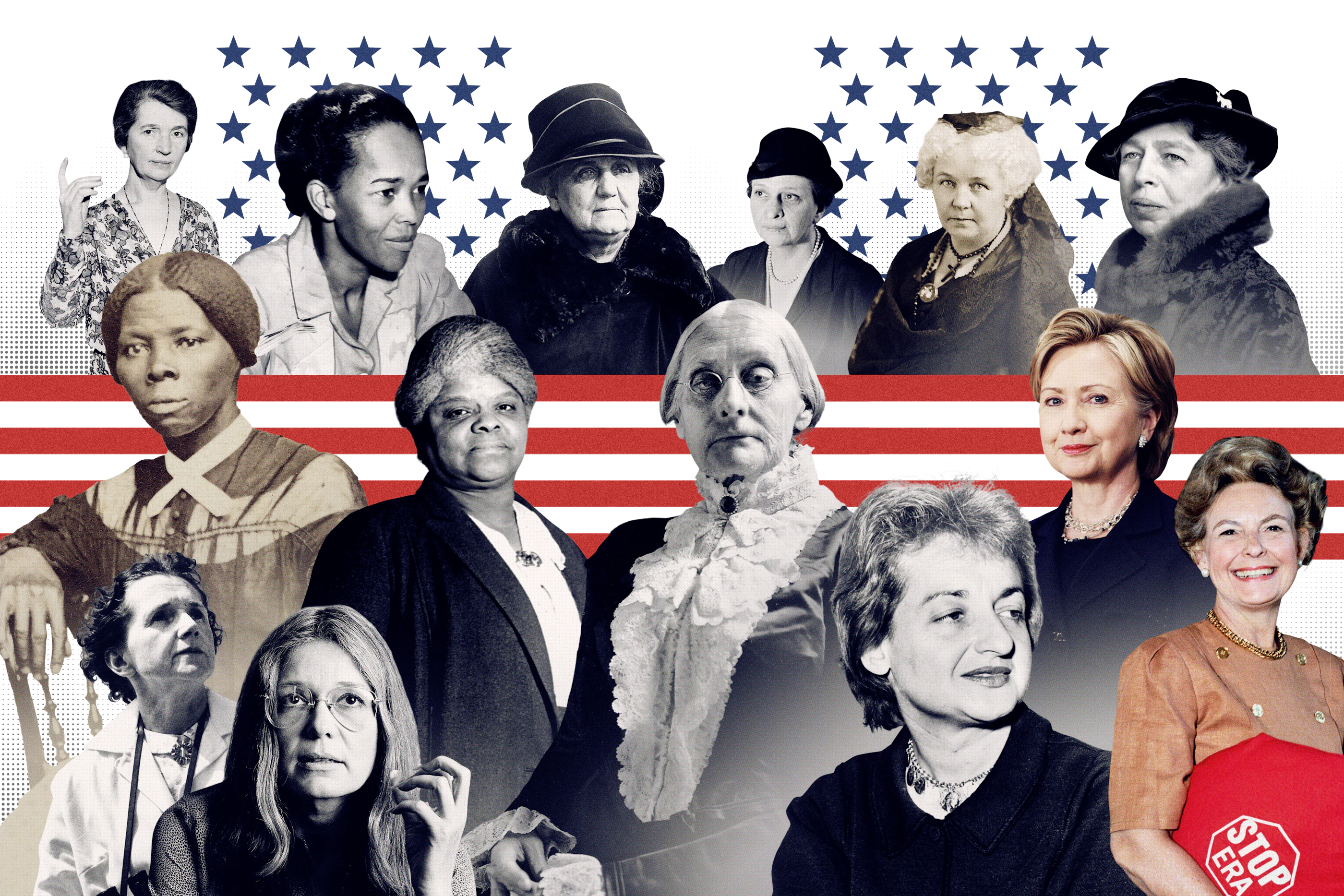
U.S.A. at 250 These 8 Americans Shaped History. We Just Don’t Agree on How. ...the other 7 historical figures profiled in this article were: the Minutemen; Charles Curtis; John Brown; Booker T. Washington; Madam C.J. Walker; D.W. Griffith; Ruth Bader GinsburgSchlafly presented an unapologetic vision of family values that resonates with many Americans to this day.
When Donald J. Trump eulogized Schlafly at her funeral in September 2016, he cast both himself and her as underdogs — perhaps reasonably. Mr. Trump looked like the most long shot presidential nominee in living memory. Schlafly, who gave him a rare early endorsement, had in the 1970s slayed the Equal Rights Amendment, which sought to give women equality under the Constitution — a seeming shoo-in, until she got involved.
By 2016, much of American life had turned nightmarish for someone like her.
Gay marriage: widely accepted. Abortion: legalized. Gender-neutral bathrooms: commonplace on many campuses. Many women no longer measured their success in marriage and children, but in financial independence and personal fulfillment.
These days, though, her arguments ring anew in our ears, as a new generation of conservative women challenges feminism’s gains.
Today, anti-feminists hold powerful roles in Washington. Social media has gone frilly with tradwives. Their reasoning echoes Schlafly’s: Homemakers enjoy special status, protected and provided for by their husbands. Why give it up?
Decades before battles erupted over unisex bathrooms for transgender people, Schafly warned that the Equal Rights Amendment would spawn co-ed bathrooms. Long before “America First” and “stop the steal,” the ultra-isolationist Schlafly accused shadowy “kingmakers” of conspiring to nominate “America Last” candidates for president. She tarred feminists as radicals, just as her heirs do now.
To combat the E.R.A., abortion and gay rights, she mobilized formerly apolitical evangelical Christians, helping to build the coalition of religious conservatives that propelled Ronald Reagan to victory and eventually ousted social moderates from the Republican Party.
The political divisions that defined those 1970s debates “only got more pronounced over the years,” leading to today’s hyper-polarization, said Marjorie J. Spruill, the author of “Divided We Stand.” “And Schlafly’s tone had a lot to do with it.”
Schlafly’s victories came wreathed in paradoxes: She presented herself as a model wife and mother, breastfeeding all six of her children, yet she had resources (her husband, a lawyer, came from wealth) and a housekeeper that allowed her to run political campaigns and churn out books, newsletters and commentary. While exalting homemaking, she lobbied (unsuccessfully) for a top post in the Reagan administration.
Calmly, she deflected accusations of hypocrisy, saying that she had raised her children before embracing what she called her “hobby” — politics. Career and homemaking, she said, came “at different times in my life.”
Feminists never tire of leveling similar charges today, against women like Erika Kirk, the conservative activist who now leads the influential organization started by her late husband, Charlie Kirk; and Katie Miller, the prominent Republican political operative who promotes motherhood as women’s highest calling.
Yet many young women are veering further left, and their conservative peers aren’t necessarily sticking to homemaking, either. At a recent Turning Point USA conference for conservative young women, several speakers openly discussed balancing family with high-powered careers. You could see Schlafly’s influence. You could also see feminism’s.
Saturday, June 20, 2026
8 Americans who Shaped History
Tuesday, June 16, 2026
Sports Gambling Triggers Legal Drama
The Phyllis Schlafly Report
By John and Andy Schlafly
The UFC Freedom 250 gladiator fights on the White House lawn were not the only high-profile bouts this week. The conservative Attorneys General Kris Kobach (R-KS) and Ken Paxton (R-TX) faced off against each other in a high-stakes legal battle precipitated by the crisis of gambling on college sports.
At a cost of $5 million, Texas Tech had recruited a star quarterback named Brendan Sorsby for its football team. Then it was discovered that the 22-year-old athlete had gambled more than $90,000 on college sports, placing more than 9,000 bets including 40 on his own Indiana Hoosiers team while a freshman there.
Millions are wagered daily on sports due to the Supreme Court ruling in Murphy v. NCAA (2018), which invalidated the federal ban on sports gambling outside of Nevada. Some $167 billion is bet on sports annually now, most of it by young men, and the World Cup that just started is expected to become the most gambled-on sporting event ever.
Most parents would be shocked to learn that an estimated 30-50% of 16-year-old boys are placing bets through their phones today. Many of the college athletes of the future are betting on sports in high school.
The NCAA prohibits gambling on college sports by its players, but Brendan Sorsby is surely not the only college athlete who has been placing bets and the NCAA ban is difficult to enforce. He just happened to admit it, and the NCAA predictably reacted by banishing him permanently from competing in college football.
Not so fast, a Texas state court then ruled by reinstating him to play for nearly this entire season. The NCAA immediately appealed, while other colleges in its Big 12 athletic conference complained about the harmful impact on the integrity of the game.
Historically, players have been banned from competing if found to have gambled on teams in their own sport. The Chicago White Sox players who were caught fixing the 1919 World Series were banned from professional baseball for life.
Pete Rose was excluded from the Hall of Fame for the rest of his life after his gambling on baseball was discovered. His highly respected teammate, the Hall of Famer Johnny Bench, agreed with that ban based on Rose’s admitted gambling.
But as other colleges began threatening to boycott Texas Tech in their schedules, the conservative Texas Attorney General Ken Paxton sprang into action. Epitomizing the sentiment of “Don’t mess with Texas,” Paxton indicated that his office would take action against any conference or college that ostracized Texas Tech.
The University of Kansas and Kansas State are members of the same Big 12 conference as Texas Tech. Their conservative Kansas Attorney General, Kris Kobach, then got into the game by saying that the conference and other colleges have the right to take Texas Tech off their schedules if Texas Tech allows an admitted gambler to play.
The Big 12 conference filed a federal lawsuit against Paxton and Texas Tech seeking a declaration of the athletic conference’s First Amendment rights to enforce its policy against gambling. Texas Tech had a state court order requiring the NCAA to allow Sorsby to play, but the conference sought a federal court order allowing it to discipline Texas Tech.
As all this drama unfolded, Texas Republicans were holding their biennial state convention in Houston. The delegates approved strengthening their platform against gambling, in a state where pro-gambling interests spent more than $10 million in the primaries to try to expand gambling there.
Sorsby has not been charged with any crime. Sports gambling is legal today in roughly 40 states, and in the other 10 states people are doing essentially the same thing on so-called prediction markets like Kalshi.
The NFL has been permissive about this issue, and allowed another player who bet on college sports, Kayshon Boutte, to play in the NFL without any suspension. He was accused of placing 8,900 bets while playing college football, and admitted that he bet until he “was completely broke.”
“I’d wake up early in the morning, and the first thing I'd do was bet,” Boutte explained. “I’d stay up late and bet. All day. All night. I had insomnia, so if I woke up in the middle of the night, phone next to the bed, I'd bet.”
On Monday, Brendan Sorsby entered the supplemental NFL draft, so that he might be selected to play for an NFL team rather than for Texas Tech. To become NFL-eligible he had to abandon his college eligibility and leave Texas Tech, moving the drama to the NFL.
But no one expects this to end the growing crisis caused by sports gambling. College athletes are kids and, as the pandemic of sports betting ensnares teenage boys and young men, it is bringing down the integrity of sports with them.
John and Andy Schlafly are sons of Phyllis Schlafly (1924-2016) and lead the continuing Phyllis Schlafly Eagles organizations with writing and policy work.
These columns are also posted on PhyllisSchlafly.com, pseagles.com, and Townhall.com.
Monday, June 15, 2026
The Catholic Patriotic Minute #50: Phyllis Schlafly
Schlafly’s whole life was a tremendous leap, powered by the dedication to hard work she learned from her parents and her courage to serve Americans through her pen and speech. Relentlessly, Schlafly’s early writing evolved into writing and public speaking, warning against the dangers of Socialism and Communism and advocating for the life of homemakers, the natural distinctions between man and woman, and the dignity of human life. Phyllis Schlafly passed away on September 5, 2016.
Tuesday, June 9, 2026
College Grads Hurt by H-1B Visas
The Phyllis Schlafly Report
By John and Andy Schlafly
There is a grim unemployment crisis for college graduates who majored in STEM – science, technology, engineering or math. An estimated 8% of recent STEM graduates are completely unemployed, which is double the national unemployment rate.
This is amid a high-tech boom producing billionaires nearly as often as coffee cups. Only a few hundred thousand American STEM graduates want a job in their field, and it should not be so difficult to make good jobs available to them.
Foreigners coming in on H-1B visas are being hired rather than Americans for many entry-level STEM jobs. There is supposed to be high growth in AI software development, but Big Tech has filled this field with H-1B foreigners, too.
The National Foundation for American Policy found that more than 80% of new H-1B applications and filings by Amazon, Apple, Facebook (Meta), Google, and Microsoft are for foreign workers to fill American jobs in AI and software development, and data science jobs.
Big Tech prefers H-1B visas because the workers become bound to the employer by the program and can then be paid less while prevented from switching to a competitor. If the visa holders want to quit to work for a rival, then they would typically lose their right to remain in the United States and could be deported.
The net result is that everyone is harmed by the H-1B program except the owners and executives of a few Big Tech companies, and the foreigners who steal the good jobs. American workers lose access to jobs taken by H-1B workers, American consumers are harmed by this interference with better competition that often results from job mobility, and entire communities are taken over by foreigners brought in on visas.
On Monday, federal Judge Leo Sorokin in Boston invalidated Trump’s long overdue reform of the H-1B visa system, by which Trump last year imposed a $100,000 surcharge on new visa applications. Liberals have been filing many of their anti-Trump lawsuits in Boston because that is now the most Democrat-appointed judicial venue in our country, reinforced by the nearly all-Democrat First Circuit Court of Appeals.
Judge Sorokin relied on the Supreme Court decision invalidating many of Trump’s tariffs by viewing them as taxes that needed to be considered first by Congress. “These federal judges are really giving us a hard time,” observed Trump.
“Between 2022 and 2023, the top companies using the H-1B program laid off 85,000 American workers, while simultaneously bringing in over 34,000 guest workers from abroad,” Sen. Bernie Sanders stated in a press release last year. He sought “to substantially increase the guest worker fees large corporations pay,” which Trump did but the federal judge in Sanders’ backyard struck it down.
Sen. Sanders claims that he’s opposed the harmful H-1B visas since his “first days as a U.S. senator,” but Phyllis Schlafly opposed this racket years before that. She wrote against H-1B visas in 2003 because they “allow corporations to displace U.S. citizens with skilled labor imported from foreign countries.”
Phyllis urged congressional Republicans to block renewal of the H-1B visa program back then. But politicians in D.C. caved to the lobbyists and voted to continue this harmful program.
The stunning upset last Tuesday in Iowa should send shock waves through every Establishment politician. Their favored candidate was Randy Feenstra, who did not even bother to participate in the debates with his primary opponents.
But Zach Lahn (pronounced Lane) seemingly came out of nowhere to win with a campaign ad promising to ban state government and universities from employing H-1B visa holders. He vowed to require disclosure in state contracts of how many Iowans would be hired, which he pointed out would “be inversely correlated to how many H-1Bs you have.”
“I reject the idea that our people won’t do these jobs,” Lahn said in criticism of the H-1B program. “We have some of the most hardworking kids in the country. I want to be hiring those Iowans here, that’s why we need to bring our kids back home, and that’s what we’ll be fighting for as governor.”
Texans are in an uproar over the H-1B program, as the fast-growing boomtown of Frisco, an hour’s drive north of Dallas, is being overrun by foreigners, many of whom arrived on worker visa programs. The enrollment by Asians is 44% of the Frisco Independent School District (FISD), and one-fifth of the town is Indian now.
There is a shortage of medical residency spots in the United States such that roughly 8,000 American medical school graduates are unable to find a place in a residency program, which is required to become a practicing physician. Yet 10,000 physicians working in the U.S., including some medical residents, are foreigners here on H-1B visas.
John and Andy Schlafly are sons of Phyllis Schlafly (1924-2016) and lead the continuing Phyllis Schlafly Eagles organizations with writing and policy work.
These columns are also posted on PhyllisSchlafly.com, pseagles.com, and Townhall.com.
Tuesday, June 2, 2026
College Crisis Caused by Judicial Activism
The Phyllis Schlafly Report
By John and Andy Schlafly
The crisis in college sports is having a ripple effect, causing colleges to eliminate programs, which then decreases their enrollment as fewer students have a reason to go there. As enrollment declines, colleges go out of business, and at least a quarter of colleges teeter on bankruptcy even during good times.
In April, President Trump issued an executive order explaining that “financial perils” caused by the crisis in college sports “could impact [colleges’] capabilities and responsibilities as Federal contractors and grantees,” and also that the “health of the university system is integral to the Federal Government’s basic functioning.”
A federal court in California caused this crisis by allowing a class action on behalf of college athletes seeking compensation, and then approving a $2.8 billion payout to college athletes dating back to 2016. Known as the “House settlement,” this includes a whopping $750 million payout to attorneys which neither colleges nor the NCAA can afford.
With the exception of men’s basketball and football, college sports programs are money-losers that serve the purpose of attracting enrollment in the college. The judicial activism from a federal court against college sports is bringing down entire colleges in the collapse.
This class action lawsuit is on appeal to the Ninth Circuit in San Francisco. Seven different groups of athletes are appealing, including women who receive almost none of the back pay, men in underappreciated sports like wrestling, and walk-on athletes who made their college team as many aspire to do.
College enrollment depends on the opportunity for all students to try to make the team in their favorite sports, without having been recruited in high school. The movie Rudy featured a walk-on who tried out and made the Notre Dame football team, and is considered one of the greatest sports movies ever made.
For more than a century, college sports worked well by keeping professionals out, and students played for the love of the game, not money. “I’d like to go exactly back to what we had and ram it through a court,” Trump said in March, and his instincts are right.
He could do that by intervening in the “House” litigation. Trump’s Solicitor General who represents the U.S. in the Supreme Court, John Sauer, was himself a “walk-on” college wrestler who became the team captain at Duke, and he could argue for a return to allowing colleges to keep compensation out of their sports.
The Senate Commerce Committee is holding a hearing on Wednesday for the misnamed Protect College Sports Act, which would mandate as federal law the opposite of what has long worked. This new federal law would force colleges to allow compensation for players by allowing them to take money for their name, image, or likeness (NIL), to the detriment of team spirit.
The Protect College Sports Act would micromanage college sports in additional ways, such as adopting team roster size limits, which makes it harder for a student to become a walk-on. This bill would place wage controls on the compensation of agents who will negotiate lucrative contracts for a few students, when there should not be any agents or compensation at all in college sports that thrived with amateur athletes.
This federal bill would prohibit the two most successful conferences, the Southeastern Conference (SEC) and the Big Ten, from expanding or merging. Never before has a federal law interfered with private associations like this.
A generation ago, college was part of the American Dream. College sports attracted students and donations by alumni, and millions of students obtained a good education and a solid foundation for the rest of their lives by attending college to play sports.
The federal lawsuit encourages NCAA Division I colleges to pay their players $20 million annually, but for most schools the money simply isn’t there. Most sports do not have a sizable television audience and will be eliminated, to save money to pay a handful of top basketball and football players who have little interest in academics.
Even before this court-ordered $2.8 billion burden on colleges, many were already going out of business. A study by the Federal Reserve Bank of Philadelphia predicted in 2024 that as many as 80 colleges might close in the next five years.
Last year 28 colleges went out of business, and during the past eight years more than 100 colleges have closed. The Huron Consulting Group found that roughly 25% of the private, nonprofit universities and colleges could close or merge in the next ten years.
Congress could help college sports by allowing a return to the amateur model, thereby ending what Trump has described as an “out-of-control financial arms race.” The Trump Administration could also stop granting visas to foreign athletes to play on college teams, which worsens this “arms race.”
John and Andy Schlafly are sons of Phyllis Schlafly (1924-2016) and lead the continuing Phyllis Schlafly Eagles organizations with writing and policy work.
These columns are also posted on PhyllisSchlafly.com, pseagles.com, and Townhall.com.
