Craig Roberts’s Kill Zone: A Sniper Looks at Dealey Plaza. (2001)
Heinz Höhne’s The Order of the Death’s Head. (2002)
H. G. Wells’s The New World Order. (2002)
Celerino Castillo’s Powder Burns. (2004)
Goethe’s Faust, “the original.” (2005)
The Orwell Reader. (2005)
Jerome Corsi’s Minutemen: The Battle to Secure America’s Borders. (2006)
Marc Stevens’s Adventures in Legal Land. (2006)
Machiavelli’s The Prince. (2007)
William Shirer’s The Rise and Fall of the Third Reich. (2007)
Edward Gibbon’s The History of the Decline and Fall of the Roman Empire. (2007)
Carroll Quigley’s Tragedy and Hope. (2007)
Edward Bernays’s Propaganda, along with an unnamed second “major” Bernays book. (2008)
Gary Allen’s None Dare Call It Conspiracy. (2012)
Walter Langer’s The Mind of Adolf Hitler.(2012)
Nuclear Roulette. (2012)
Freud’s General Introduction to Psychoanalysis. (2013)
Phyllis Schlafly’s Who Killed the American Family? (2014)
Aldous Huxley’s The Doors of Perception and Brave New World Revisited. (2014, 2024)
Brad Thor’s Code of Conduct. (2015)
Donald Trump’s The Art of the Deal. (2018)
Arthur C. Clarke Childhood’s End (2019)
Mein Kampf. (2020)
John Holdren and Paul Ehrlich’s Ecoscience. (2021)
Sun Tzu’s The Art of War, plus Time-Life encyclopedias about the occult and the Old West. (2022)
Anatoliy Golitsyn’s The Perestroika Deception. (2022)
Winston Churchill’s A History of the English-Speaking Peoples. (2024)
William Bramley’s The Gods of Eden. (2024)
J.D. Vance’s Hillbilly Elegy. (2024)
William Cooper’s Behold a Pale Horse. (2025)
Saturday, October 10, 2026
Phyllis Family Book on the List

Thursday, September 24, 2026
‘Big Sister’ warning resurfaces
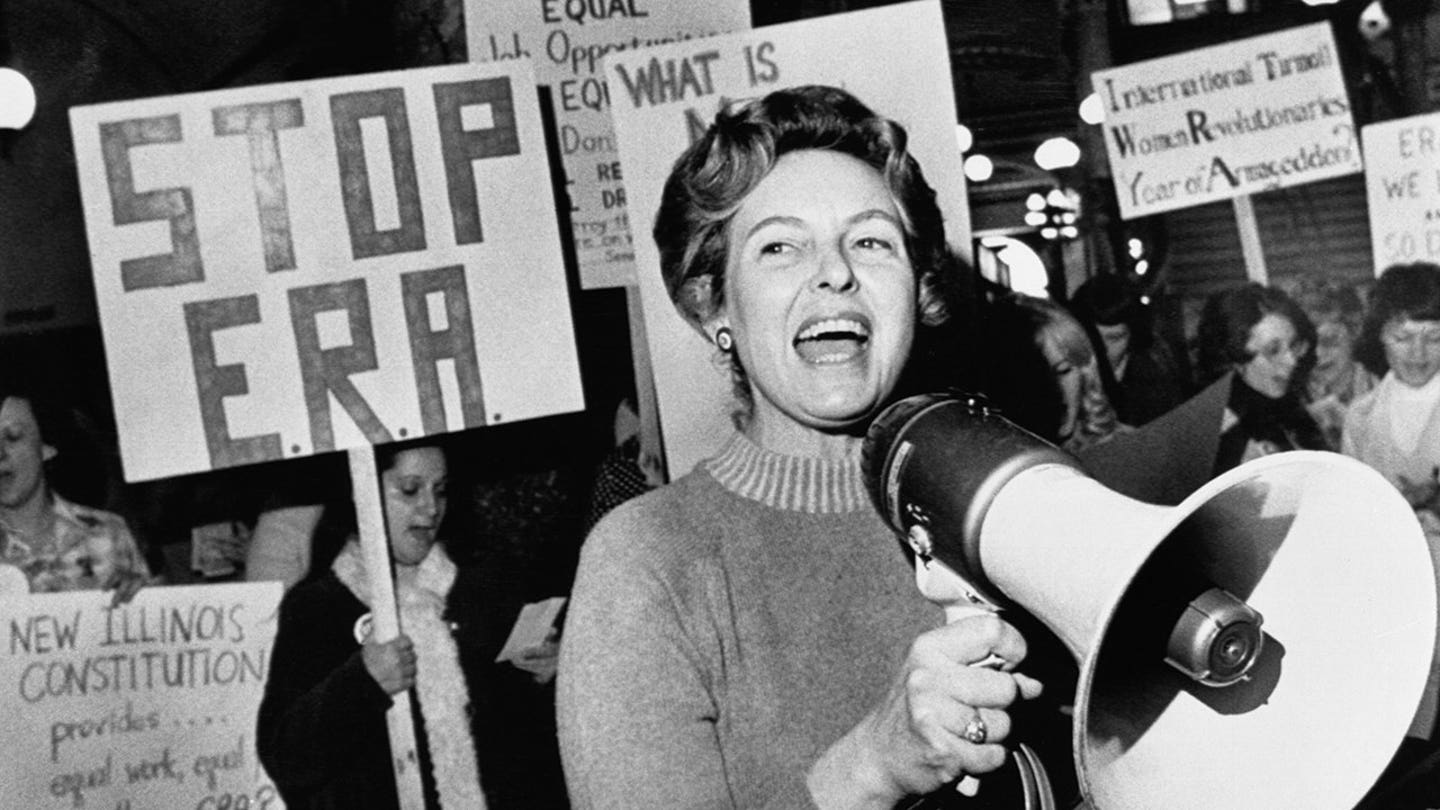
Twenty-seven years before Massachusetts proposed to dramatically expand a taxpayer-funded program sending nurses into the homes of families with newborns, legendary conservative firebrand and grassroots women’s leader Phyllis Schlafly posed a question that her daughter says now sounds remarkably familiar."Are the American people willing to allow government agents to come into their homes to ‘advise’ them how to care for their babies?" Schlafly wrote in a March 1999 column titled, "Watch out for ‘Big Sister’ as Well as ‘Big Brother.’" ...
For Anne Schlafly, chairman of Eagle Forum and Phyllis Schlafly’s daughter, her mother’s warning has now taken on new resonance.
"My mother was very prescient about the things that could happen if we let government intrude into our family lives," Schlafly told Fox News Digital.
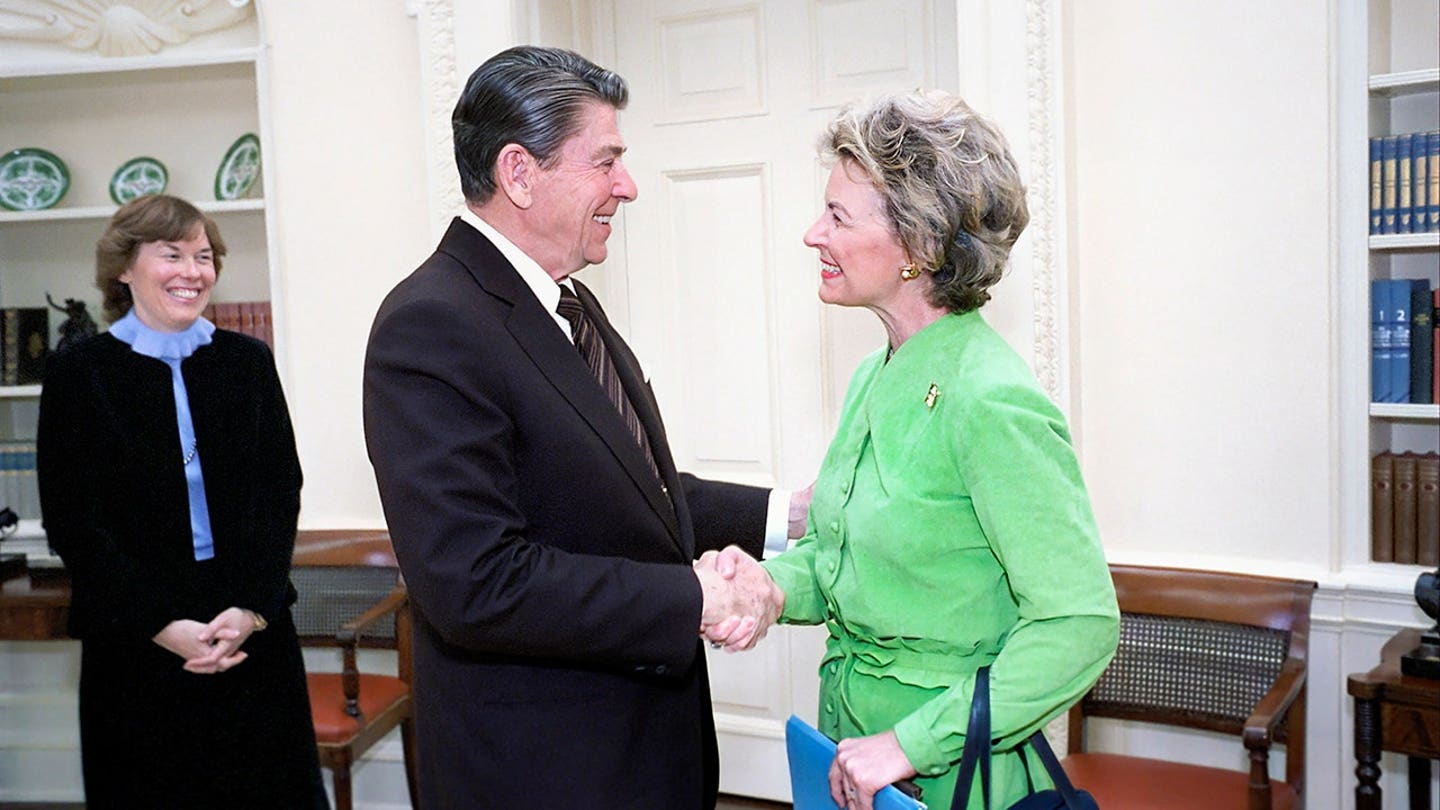
President Ronald Reagan meets with American conservative activist Phyllis Schlafly in the White House Oval Office in Washington, D.C., March 21, 1983. (Universal History Archive/Univer)"Her point was a government agent or an agent of the government has no business in your home, in your castle, snooping around and determining whether or not you’re raising the children the way the government wants you to raise the children," she said. "After all, the home is our castle."
Phyllis Schlafly’s 1999 column focused on Healthy Families America and similar home-visiting initiatives, warning about programs that screened families for risk factors, connected parents with health and social services and offered parenting guidance inside the home.
She also questioned whether programs officially described as "voluntary" would always operate that way in practice.
Wednesday, August 5, 2026
Campaign to put Trans Rights in Constitution
Today, voters in Missouri’s 1st Congressional District head to the polls for the Democratic primary. On the ballot is former Rep. Cori Bush, seeking a return to Congress after losing her seat in 2024. If voters give her another chance, she has made clear what her top priority would be: enshrining abortion and transgender “rights” into the U.S. Constitution.Bush said she wants to advance the Equal Rights Amendment (ERA) so that it becomes the 28th Amendment to the Constitution—which, in her view, could permanently lock abortion access and trans agendas into the nation’s foundational document. ...
Even in the early 1970s, critics foresaw serious problems. The STOP ERA movement, led by Phyllis Schlafly, warned that the amendment would likely trigger “government-financed abortion, the legal dissolution of biological differences between men and women, and restrictions on women’s legal rights in matters of divorce.” Those concerns never fully faded.
Monday, July 20, 2026
Family not merely a private arrangement
In conducting research for my upcoming book about American culture, I came across the controversial figure of Phyllis Schlafly. I remember her as someone my mother liked, as she was exactly the demographic Phyllis tried to reach: a Christian homemaker. I vaguely remembered the controversy surrounding the Equal Rights Amendment growing up, and the argument that while its supporters claimed they wanted “equal rights for women,” its detractors believed it would strip women of certain protections and privileges, such as exemption from the draft. ...Essay is reprinted here.Now we come to the usual complaint about Schlafly, other than the fact that she was not a Marxist feminist in the style of today—or even the 1970s. Even those attempting to be “fair” to her often lapse into the same condescending refrain: “She was so intelligent and ambitious, yet she wanted to deny rights to women. Such a paradox.” Or: “She left the home, but wanted to trap all other women inside it.”
By now, these observations are so trite and thoughtless they hardly merit serious attention. ...
To Schlafly, the family was never merely a private arrangement. It was the central institution through which morality, memory, culture, and continuity were transmitted across generations. ...
But perhaps Schlafly’s greatest insight was this: women traded away a profound form of civilizational power. They exchanged the ability to shape the culture of families, neighborhoods, communities, and future generations for peripheral participation in bureaucratic and corporate systems that neither know nor love them. Modern ideology snookered women to surrender deep and lasting influence for managerial status inside institutions built by technocrats.
Saturday, July 11, 2026
Meet Gen Z's Phyllis Schlafly
Over the past few months, the powerful Heritage machine has pushed out book promo for Waters, put her on panels, and given her a new podcast — “Rethinking Fertility.” In other words, they want her to be a Gen Z Phyllis Schlafly — advising young women to stay at home while she, herself, enjoys a high-profile career writing books, giving talks, and shaping national policy.I listened to a Waters podcast, and she is certainly not dangerous, not robbing girls of choices, or advising young women to stay home.I don’t think she’d mind the comparison: in her book, Waters lauds Schlafly as a “revolutionary” who “didn’t abandon her home, her femininity, or her faith.” She also cites Schlafly as precisely who American women should strive to be: a “model of traditional womanhood [that] encourages public engagement, but only after family duties have been honored.” ...
That doesn’t mean Waters isn’t dangerous; of course she is. ...
Waters, like Schlafly, found a way to have her cake and eat it too: working while making it harder for other women to work, embracing her professional drive while telling young women their ambition will make it harder for them to be mothers. Most egregiously, she's robbing other young women and girls of the choices she was privileged enough to have.
It is strange how upsetting it is for feminists to hear a woman who is happy to be a wife and mother.
Friday, July 10, 2026
NY Times Slant on Women in History
History? New York Times Puffs RBG, Paints Phylllis Schlafly as Hyper-Polarizing Hypocrite
In the newspaper on July 3, The New York Times tried to play Historian in a series of little profiles under the headline:
These 8 Americans Shaped History.You could see the obvious contrast in the modern subjects: Phyllis Schlafly vs. Ruth Bader Ginsburg.The Debate Over How Continues.
Times reporter Jeremy Peters was pro-Ginsburg, except she took too long to retire. He began: “Ruth Bader Ginsburg had attained folk hero status as the notorious R.B.G. for her lifetime of legal work dismantling gender bias in the law. But her decision not to retire has put an asterisk on her legacy.”
Times reporter Vivian Yee complained "anti-feminist" Schlafly “slayed” the so-called Equal Rights Amendment, but the cultural Left was winning:
By 2016, much of American life had turned nightmarish for someone like her.In these eight profiles, Times reporters used “conservative” 12 times. There were no words like “liberal” or “left-wing” or “progressive” for Ginsburg. But Yee complained Schlafly “tarred feminists as radicals, just as her heirs do now.” The Left’s positions on abortion on demand, gay marriage, and biological males in women’s sports are never “radical.”Gay marriage: widely accepted. Abortion: legalized. Gender-neutral bathrooms: commonplace on many campuses. Many women no longer measured their success in marriage and children, but in financial independence and personal fulfillment.
And then, Yee suggested Schafly was “divisive” – and somehow Ginsburg wasn’t?? They also accused Schafly of hypocrisy:
The political divisions that defined those 1970s debates “only got more pronounced over the years,” leading to today’s hyper-polarization, said Marjorie J. Spruill, the author of Divided We Stand. “And Schlafly’s tone had a lot to do with it.”NewsBusters acquired an unpublished letter sent to the editor of the New York Times from Anne Schlafly, Phyllis’s daughter:Schlafly’s victories came wreathed in paradoxes: She presented herself as a model wife and mother, breastfeeding all six of her children, yet she had resources (her husband, a lawyer, came from wealth) and a housekeeper that allowed her to run political campaigns and churn out books, newsletters and commentary. While exalting homemaking, she lobbied (unsuccessfully) for a top post in the Reagan administration.
America's 250th anniversary was an opportunity to reflect honestly on the men and women who shaped our nation. Instead, The New York Times has chosen to spotlight the shortcomings of eight influential Americans while giving comparatively little attention to the accomplishments that earned them a place in history.Anne Schlafly told NewsBusters: “Why is The New York Times so reluctant to engage with competing viewpoints on issues like feminism? A publication that prides itself on open debate should be willing to examine whether the promises of modern feminism have matched the lived experiences of women, or whether alternative perspectives deserve a fair hearing.”Among those featured is my mother, Phyllis Schlafly, who is portrayed as a hypocrite because she championed the importance of mothers and homemakers while remaining active in public life. But that ignores an important fact: she raised her six children before devoting herself fully to politics, often saying that homemaking and public service came at different seasons of her life. Women do not surrender their voice when they have children, and mothers have every right to help shape the public policies that affect their families.
Without ever holding public office and while living in a Midwestern town of just 35,000 people, my mother inspired millions of American women to become engaged citizens. A decade after her death, Americans are still debating her ideas. That enduring influence is why she deserves to be remembered as one of our nation's most consequential figures, not reduced to a caricature.
Feminists suggest they want women to have choices, but they really don’t believe it. They mock their choices if it’s being a housewife (God forbid being a “tradwife”) or working in conservative politics. Yee wrote "feminist never tire" of leveling the hypocrisy charge today, against conservative women like Erika Kirk and Katie Miller.
Sunday, June 28, 2026
The Most Important Women in American History
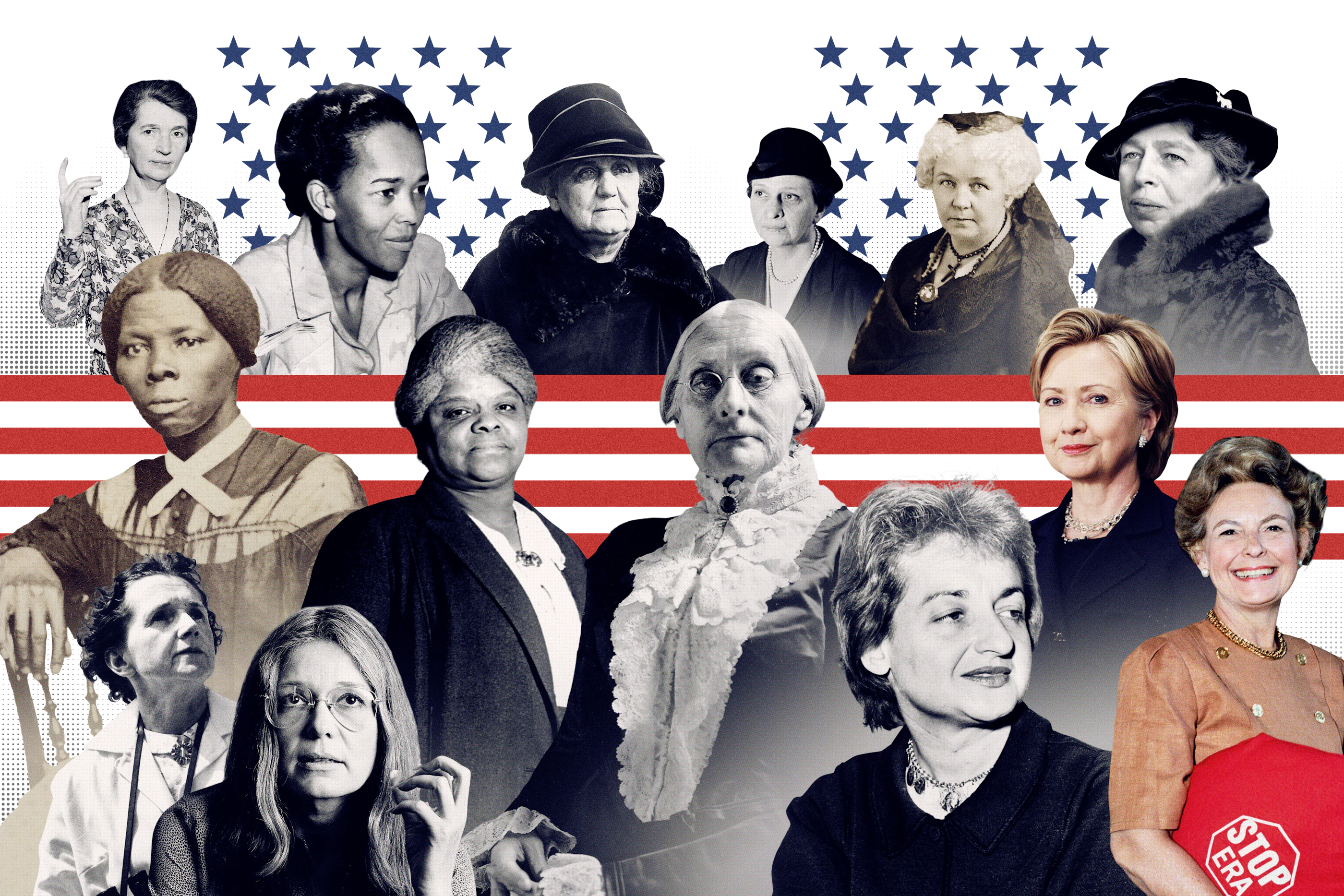
The New Republic magazine published a list of the ten Most Important Women in American History.
T-10. Phyllis Schlafly The slayer of the Equal Rights Amendment, Schlafly mobilized “the housewife image to fulfill her deep political ambitions—a model for everyone from Ann Coulter in the 1990s to the tradwives of today,” wrote Vanderbilt University’s Nicole Hemmer.
Saturday, June 20, 2026
8 Americans who Shaped History

U.S.A. at 250 These 8 Americans Shaped History. We Just Don’t Agree on How. ...the other 7 historical figures profiled in this article were: the Minutemen; Charles Curtis; John Brown; Booker T. Washington; Madam C.J. Walker; D.W. Griffith; Ruth Bader GinsburgSchlafly presented an unapologetic vision of family values that resonates with many Americans to this day.
When Donald J. Trump eulogized Schlafly at her funeral in September 2016, he cast both himself and her as underdogs — perhaps reasonably. Mr. Trump looked like the most long shot presidential nominee in living memory. Schlafly, who gave him a rare early endorsement, had in the 1970s slayed the Equal Rights Amendment, which sought to give women equality under the Constitution — a seeming shoo-in, until she got involved.
By 2016, much of American life had turned nightmarish for someone like her.
Gay marriage: widely accepted. Abortion: legalized. Gender-neutral bathrooms: commonplace on many campuses. Many women no longer measured their success in marriage and children, but in financial independence and personal fulfillment.
These days, though, her arguments ring anew in our ears, as a new generation of conservative women challenges feminism’s gains.
Today, anti-feminists hold powerful roles in Washington. Social media has gone frilly with tradwives. Their reasoning echoes Schlafly’s: Homemakers enjoy special status, protected and provided for by their husbands. Why give it up?
Decades before battles erupted over unisex bathrooms for transgender people, Schafly warned that the Equal Rights Amendment would spawn co-ed bathrooms. Long before “America First” and “stop the steal,” the ultra-isolationist Schlafly accused shadowy “kingmakers” of conspiring to nominate “America Last” candidates for president. She tarred feminists as radicals, just as her heirs do now.
To combat the E.R.A., abortion and gay rights, she mobilized formerly apolitical evangelical Christians, helping to build the coalition of religious conservatives that propelled Ronald Reagan to victory and eventually ousted social moderates from the Republican Party.
The political divisions that defined those 1970s debates “only got more pronounced over the years,” leading to today’s hyper-polarization, said Marjorie J. Spruill, the author of “Divided We Stand.” “And Schlafly’s tone had a lot to do with it.”
Schlafly’s victories came wreathed in paradoxes: She presented herself as a model wife and mother, breastfeeding all six of her children, yet she had resources (her husband, a lawyer, came from wealth) and a housekeeper that allowed her to run political campaigns and churn out books, newsletters and commentary. While exalting homemaking, she lobbied (unsuccessfully) for a top post in the Reagan administration.
Calmly, she deflected accusations of hypocrisy, saying that she had raised her children before embracing what she called her “hobby” — politics. Career and homemaking, she said, came “at different times in my life.”
Feminists never tire of leveling similar charges today, against women like Erika Kirk, the conservative activist who now leads the influential organization started by her late husband, Charlie Kirk; and Katie Miller, the prominent Republican political operative who promotes motherhood as women’s highest calling.
Yet many young women are veering further left, and their conservative peers aren’t necessarily sticking to homemaking, either. At a recent Turning Point USA conference for conservative young women, several speakers openly discussed balancing family with high-powered careers. You could see Schlafly’s influence. You could also see feminism’s.
Monday, June 15, 2026
The Catholic Patriotic Minute #50: Phyllis Schlafly
Schlafly’s whole life was a tremendous leap, powered by the dedication to hard work she learned from her parents and her courage to serve Americans through her pen and speech. Relentlessly, Schlafly’s early writing evolved into writing and public speaking, warning against the dangers of Socialism and Communism and advocating for the life of homemakers, the natural distinctions between man and woman, and the dignity of human life. Phyllis Schlafly passed away on September 5, 2016.
Monday, May 18, 2026
America must put babies and mothers first
No job is more vital than motherhood
By Anne Schlafly
"Feminism has changed the way women think, and it has changed the way men think, but the trouble is, it hasn't changed the attitudes of babies at all," said my mother, Phyllis Schlafly. I am so fortunate that my mother put babies first. In the 1960s and 1970s, a new ideology was fashionable: that women do not need or want either men or babies. Phyllis Schlafly lived a fulfilling life centered on her husband and children; which was in stark opposition to the idea that single women are happier alone.
I am so happy that she did put babies at the center of the conversation, because, as her child, I was the beneficiary of her putting babies first.
The current birth dearth is not due to lack of government money; it is due to a culture that tells young women to put career first and that men are expendable. Today, 40% of births in the United States are without the benefit of marriage. And marriage is definitely a benefit for the child. Children who are raised with a mother and a father married to each other are the most privileged group in America. These children are more likely to finish school, get employed, earn more money, be happier and healthier, and also to start their own families.
Intact families should be celebrated, not economically punished by bad tax policies. A true choice for mothers is the choice to nurture their own children, not to succumb to the economic and social pressures for them to farm them out to institutional day care. Mothers should never be economically punished for raising their own children.
Babies were always the first priority for Phyllis Schlafly. She especially liked to talk to babies. Whenever she saw a baby or toddler in public, she would immediately engage in an active conversation with the child. Today, digital interactions have replaced much face-to-face communications and our daily spoken word count has diminished. Texting is a poor substitute for talking! Babies need to hear a rich variety of words in order to develop speech, especially the sound and inflection of their own mother’s voice. Institutional day care cannot provide the same vibrant, nurturing chatter that comes from a mother.
Phyllis Schlafly rightly saw that feminist ideology devalued motherhood. She started an award for the Full-time Homemaker of the Year to honor women who prioritize their babies. Phyllis asked: would you rather be in an office instructed by a boss or managing your household from your own kitchen? She rejected the phrase "working mothers" to describe employed women, because, as she said, "all mothers work all the time".
The concept of taxpayer-paid day care for young children reflects a misplaced understanding of who is responsible for their care. Young children want and need their parents, not a nanny state, to look after them. Government welfare programs encourage the disintegration of the family by leading mothers to seek government support rather than support from fathers. Subsidized day care can undermine the family unit by diminishing the provider's role in the home. Americans consider whether it is wise policy to encourage mothers to leave their babies with government employees. What most mothers desire in paid work is to work inside their home or to work a flexible schedule that allows them to prioritize their family.
Americans spent $11B more on Mother's Day than Father's Day: ReportVideo At Eagle Forum, we believe in public and private virtue, meaning taxpayer money should be spent wisely and families should have control over their own households. If Congress truly wanted to help families, it should increase the dependent deduction on income taxes. Those savings would directly benefit families, without routing taxpayer money through a government intermediary.
Here is who loses under taxpayer-paid babysitting:
The child loses because what the child most wants is mother care, not day care. Day care may be expensive, but mother care is priceless.
The mother loses because no one cares more about her child than she does. The day care worker can never be emotionally invested in the welfare of the child.
The day care workers lose because wages are still low. Increasing the supply of day care will not raise workers’ wages.
The taxpayers lose because when the government pays, prices rise (as we have seen in the ever-rising prices of college education and health care). The subsidies will ensure that the day care businesses can raise their prices without losing customers.
Stay-at-home mothers lose as they do not receive any subsidy for choosing to remain at home and raise their own children. They have resisted the social pressure to return to paid employment and place their children in institutional babysitting.
However, there are some winners under taxpayer-paid babysitting:
Day care bureaucrats win because they can expand their business models. As in education, additional government funding often goes to administration rather than workers. Instead of supporting small family-run daycares, the industry will shift toward larger, institutional services.
Politicians win by pretending to give money to the people.
No job is more vital than motherhood. We honor all mothers who choose this important job.
Anne Schlafly is the Chairman of Eagle Forum and the daughter of Phyllis Schlafly.
Thursday, April 30, 2026
How tradition empowers women
Did Phyllis Schlafly prove that tradition empowers women?Apr 28, 2026 #PhyllisSchlafly #MichaelKnowles #Tradition
History reveals that women have always played significant roles in their communities and political spheres, long before modern movements took shape. Phyllis Schlafly stands as a prime example of someone who successfully balanced raising a large family with monumental political influence, effectively leading the opposition to the Equal Rights Amendment. This perspective argues that recognizing and embracing the unique, inherent strengths of womanhood is the true path to avoiding disadvantage. It challenges the modern narrative by suggesting that tradition and domestic roles are not barriers, but rather complementary to a woman's public and professional potential.
I made my point though, which is that you say throughout history, including long before feminism ever came onto the scene, women did plenty of things, you know, in addition to just being barefoot and pregnant in the kitchen, right? They had uh they were involved in their community. They had side hustles, as you put it. Um, so so they did all these things. I mean, I think of the most famous anti-feminist American of the 20th century. It was Phyis Schlafley. Phyllis Schlafley had six kids. She was a housewife. She uh said the only person whose permission she needs for her political activism is her husband's which irritated feminists to no end. She's one of the most important political figures of the whole century.
She single-handedly killed the Equal Rights Amendment, traveled all over the country, one of the most vaunted figures in the American right. Uh she she was able to do a lot of things in public, but she recognized that her particular role that her husband never could have, that no man on earth ever could have, even if he kids himself, is to have children, to be a woman, to be graceful, to to do the things that men can't do. And so she can do she can do things beyond that as well. But uh if if you erase the particular advantages of women, then women are are put at a disadvantage.
Friday, March 20, 2026
Most Significant American Women
Phyllis Schlafly (Aug. 15, 1924 – Sept. 5, 2016):Schlafly was a prominent conservative activist, attorney, author, and political activist. She became one of the most influential figures in modern U.S. conservatism, especially for her successful grassroots campaign against the Equal Rights Amendment in the 1970s.
Schlafly argued it would eliminate protections for women (like military draft exemptions, alimony preferences, and Social Security benefits for dependent wives) and force unwanted changes. The ERA fell short of the required state ratifications by 1982, largely due to her efforts.
Schlafly founded the Eagle Forum in 1972, a conservative organization focused on "pro-family" issues. She opposed feminism, abortion, gay rights, and comprehensive sex education, arguing for traditional gender roles and "family values."
Wednesday, December 10, 2025
The most important anti-feminist
In 1982, Phyllis Schlafly, perhaps the most important anti-feminist in American history, debated the radical feminist law professor Catharine MacKinnon. Schlafly believed that sexism was a thing of the past; to her, if women had different roles in society than men, it was due to their distinct talents and inclinations. She herself, she said, had never experienced discrimination.
Sunday, November 2, 2025
National Review on Phyllis Schlafly
There are responses by Mark Hemingway and Anne Schlafly, archived here.
Lu wrote a brief rejoinder.
Lu takes some unnecessary and unfounded cheap shots.
Update: Another response is National Review Smears Schlafly.
Thursday, September 25, 2025
Phyllis was right about the ERA
Ted Meehan writes:
In the late 1960’s and early 70’s, as the feminist movement was rising in influence, its leaders wrote and promoted passage of an Equal Rights Amendment (ERA) presumably to guarantee the rights of women. Very few people saw any problem with agreeing that women and men should be equal under the law.The prescient Phyllis Schlafly led opposition to passage of the ERA, and took plenty of abuse for doing so. What objection could justify opposing such a nice gesture that codified what nearly everyone already believed?
Phyllis recognized this as a legislative Trojan Horse that could force upon America, a number of unintended results that very few people approved. She feared passage would open the door to legalizing abortion. She warned that some people could use the ERA to justify men entering women’s bathrooms or locker rooms. She also believed that ERA could remove some legal protections for women – like Title IX. She was called an alarmist and was ridiculed. But a look at America in 2025 shows her to be the visionary she was.
Some public service jobs have physical requirements. A fire department or police candidate may be required to lift and carry a 200-pound man for 100 yards in under 45 seconds. If women firefighters are physically unable to perform such a task, are they disqualified? Well, no. Recognizing the unequal physical attributes of men and women, some physical qualifications were lowered – only for women – to allow some women to qualify. Discrimination lawsuits by men have not been noted. But a strict interpretation of the ERA would certainly prohibit lowering physical standards to favor one gender over the other.
The pseudo-scientific transgender movement has had nearly no effect at all on men’s sports. Can anyone recall reports of men feeling threatened by a transitioning female displacing male athletes on any sports teams? There have been none! But we regularly see controversy over female records being broken by biological males. Or females being displaced or injured after being physically overmatched by a post-pubescent biological male. We read reports of trans-identifying biological males entering female locker rooms, or bathrooms – with some even sexually assaulting the females! Once again, score this one for Phyllis Schlafly.
What about abortion? How could something like that possibly be justified by the ERA? Well, today three pro-abortion judges – Christine Donahue, Kevin Dougherty, and David Wecht (up for retention) — are citing ERA to argue that a “gender-based law” is unconstitutional. They argue that since only mothers (females) are prohibited from having abortions, then laws regulating abortion, discriminate only against women, and so they are unconstitutional. So, for these judges, the ERA contradicts and supersedes basic laws of nature! Imagine the outcry from feminists if the same abuse of logic was directed at them!
The Equal Rights Amendment is not a part of our federal Constitution, but the passage of a state version in Pennsylvania in 1971 should not be cited to declare abortion to be a constitutional right — or to require taxpayers to fund elective abortions. Our elected legislature — with approval by our elected governors — has passed laws to regulate abortion – as had been required by the since-overturned Roe v. Wade decision, with the recent Dobbs decision. Absent Roe, no federal law imposes abortion on states. Roe’s overturning should teach us that laws passed by legislators – not lawsuits by profit-motivated abortion businesses, decided by pro-abortion judges – should be the basis for governance.
Friday, September 19, 2025
Memorial to Charlie Kirk
Charlie Kirk was a bold and steadfast leader whose voice rang clear in defense of American values. As the founder of *Turning Point USA*, he led a new generation of young conservatives toward understanding the importance of traditional American principles. Charlie was unwavering in his commitment to the values that built this great nation—faith, family, and freedom. He was a tireless advocate for conservative ideas, especially in the education system, where liberal ideologies have long held sway. With grace and conviction, Charlie stood against the tide of political correctness, speaking truth to power even when it was unpopular. His courage inspired countless young Americans to take a stand and fight for the future of this country.His passing leaves a void, but Charlie's legacy endures in the hearts of those he inspired. Just as Phyllis Schlafly fought to defend American institutions and the sanctity of the family, Charlie understood that the future of our nation rests in the hands of the next generation. His work was never about the accolades or the spotlight—it was about the fight for freedom, a fight he believed every American should join. Charlie’s passion for our country and his dedication to the principles of limited government and personal responsibility will continue to inspire. His influence on the conservative movement will never fade, and his memory will live on in the work of those who carry on his mission.
You can ask AI-Phyllis questions here.
Sunday, April 27, 2025

Saturday, August 24, 2024
Maher Defends Not Having Kids
it's cat 1:03 ladies. Vance says the country is being 1:07 run by them. in 2020 he said not having 1:10 kids makes people more sociopathic and 1:13 less mentally stable and the people who 1:15 are most deranged and most psychotic are 1:17 people who don't have kids. ...So are people without kids less mentally stable? He never answers that.it's 2024 and 1:35 you're still saying that people who 1:37 don't marry and raise kids are inferior 1:40 weirdos. thanks philis shafley. let me 1:42 check my beeper to see if 1993 1:46 called. you 1:50 know 1993 that's the year I went on the 1:53 air with my first show Politically 1:56 Incorrect and 2:02 and one of the themes that made that 2:05 show different and you know 2:08 incorrect was that the host was always 2:11 pushing back against the idea that 2:13 choosing to remain childless and single 2:15 your whole life was to say the least odd
The causality might go the other way, with crazy people less likely to marry and have kids.
Maher says he pays school taxes, and is offended by any suggestion that he is less virtuous. Now he feels vindicated by the millions of others who have decided to not have kids.
The problem here is that Maher, and many others like him, do not understand correlations. No one is saying that he should have kids.
Thursday, August 15, 2024
Phyllis Schlafly: the original tradwife
She was the anti-feminist who had it all
by Sarah Ditum
You could call Phyllis Schlafly the first trad wife. A mother-of-six, she would introduce herself in public as a “lawyer’s wife”, and embodied all the feminine virtues: “A blonde with deep blue eyes, a figure that can still be called willowy and a winning smile, she does not have to shout to get attention,” panted the NYT in a 1976 profile.
In her 1977 book The Power of the Positive Woman, she celebrated the “unique dignity” of the housewife’s vocation. Status, money, travel, power were all false gods: “None of those measures of career success can compare with the thrill, the satisfaction, and the fun of having and caring for babies, and watching them respond and and grow under a mother’s loving care. More babies multiply a woman’s joy.”
Psychology, not sexism, explained the difference between male and female lives. Men and women have different bodies; it followed that they would have different brains too. “Where man is discursive, logical, abstract, or philosophical, woman tends to be emotional, personal, practical, or mystical. Each set of qualities is vital and complements the other.” It would be mere quibbling to ask where “logical” ends and “practical” begins, or to locate the precise boundary between “philosophical” and “mystical”.
What mattered to Schlafly, who was born 100 years ago today, was that there are two sexes, whose stable, global and ineradicable differences cast them in complementary roles, which meant that she was also casually contemptuous of same-sex relationships. To Schlafly, abortion was a kind of violence not only against the unborn, but (and perhaps more importantly) against relations between men and women. To seek to make women somehow free from reliance on men — as the women’s liberation movement did — was nothing less than “neuterising society”.
With her modest tailoring, rigidly set hair and chic strings of pearls, Schlafly would be easy to mistake for an old-fashioned kind of woman. But her paeans to feminine accomplishments could sit happily in the Instagram captions of a modern domesticity influencer, and her analysis of gender politics barely distinguishable from the work of “reactionary feminists” such as Mary Harrington and Louise Perry. Schlafly was a reactionary, but she was also a visionary.
“Schlafly was a reactionary, but she was also a visionary.” As she mobilised her rhetorical skills and her network of volunteers against the Equal Rights Amendment to the US constitution, the feminists floundered in response. Their prescription of freedom for women was experienced by the Schlafly cohort as an attack on feminine privileges; worse, it was an attack on the kind of woman these God-fearing homemakers were. They were a living riposte to the idea of a women’s movement: these women wanted no part of it
For feminists, this lack of sisterhood could be infuriating, and Schlafly reaped all the benefits of goading her opponents. Betty Friedan, author of The Feminine Mystique, came to pieces during a 1973 debate against the personification of the phenomenon she had defined. After Schlafly said women were simply unwilling to do the work required to be elected to office, Friedan called Schlafly “a traitor to your sex, an Aunt Tom” and said: “I’d like to burn you at the stake.”
Such an unfeminine outburst would always fail against Schlafly’s grace and composure, especially from a woman no one was likely to describe as beautiful (the satirical website Reductress put Friedan at number one on a list of “5 Historical Ugly Women Your Daughter Can Idolize for the Right Reasons”). When Schlafly wrote in The Power of the Positive Woman that “if the… strident ‘spokespersons’ of women’s liberation would quietly fade away, dignified and capable women would have a better chance of being elected to public office”, it’s easy to imagine that she had her encounter with Friedan in mind.
Cooler heads on the other side to Schlafly could only express a kind of reluctant admiration. Other conservative women, noted Andrea Dworkin in her book Right Wing Women, inevitably revealed conflicts and struggles as they fought to surrender their own desires and become the good wives and mothers that God and nature had supposedly fitted them to be. Anita Bryant or Tammy Faye Bakker had a streak of tragedy to them. They expounded family values in their own statements, but their lives seemed to be exhibit A for the feminist analysis.
Not Schlafly, though: “She seems possessed by Machiavelli, not Jesus. It appears that she wants to be The Prince. She might be viewed as that rare woman of any ideological persuasion who really does see herself as one of the boys, even as she claims to be one of the girls,” wrote Dworkin. Schlafly had no sympathy for weakness, and no apparent weaknesses of her own. In The Power of the Positive Woman, she presents herself, unabashedly, as the Positive Woman to be emulated. Any unhappiness or frustration in the reader simply reveals her own lack of “positive mental attitude”.
This might seem like unfeminine immodesty from Schlafly, but of course it’s allowable because she had already defined her scope to exclude any possible competition with men. Schlafly could be the best at being a woman, without threatening masculine authority. As a political campaigner, she was fearsomely effective. Before Schlafly’s lobbying, the ERA had appeared to have a clear path to ratification; thanks in large part to her efforts, it never passed into statute.
And yet, the place of women was a late blooming interest for Schlafly. She may have been a lawyer’s wife, but she had a master’s degree in government, and a long career in conservative think tanks, including influential work on anti-communism. Her first book was A Choice Not an Echo: The Inside Story of How American Presidents Are Chosen, which gave a paranoid account of how “a small group of secret kingmakers, using hidden persuaders and psychological warfare techniques, manipulated the Republican National Convention”.
In her later writing, she would mock feminists for believing in a “conspiracy of male chauvinist pigs” determined to deny them their happiness; but in A Choice Not an Echo, Schlafly is in full tin-foil hat mode as she describes a network of secret meetings and covert influence designed to hijack the Republican Party away from the Right. There is urgency to her message: the book was released in the summer of 1964, ahead of the November election in which Schlafly’s favoured candidate Barry Goldwater would represent the Republicans against Lyndon B. Johnson.
A Choice Not an Echo was judged a success in bringing activists over to the Goldwater cause. Goldwater himself, however, was a disaster. The Republicans suffered a historic wipeout: Goldwater won only his home state of Arizona, and five states in the deep south who were historically Democratic but were attracted by Goldwater’s resistance to the Civil Rights Act. America was not ready for the kind of culture war that Schlafly had in mind.
But it would be. Goldwater’s strange constituency of “businesspeople, Southerners, Midwesterners and libertarians” would eventually become the soul of the Republican Party: what seemed at the time like a total defeat for conservatism was actually laying the path for the coming of Ronald Reagan. And the inflammatory rhetoric and sense of victimhood that had made Goldwater repulsive in 1964 would return, eventually, in the form of Donald Trump — who would turn them into assets rather than faults.
Schlafly received little reward for her prescience, though. Newspaper reports said that she had hoped for an appointment to the Pentagon under Reagan; no appointment came, although her dedication to the Right-wing cause and her interest in security could hardly be doubted. Challenged by the feminist lawyer Catharine McKinnon on whether this was sex discrimination in action, Schlafly shrugged the implication away with her usual deftness: “It is the Reagan administration’s loss that they didn’t ask me, but it isn’t my loss.”
When she died in 2016, Trump — then the Republican nominee — eulogised her at her funeral. “Her legacy will live on every time some underdog, outmatched and outgunned, defies the odds and delivers a win for the people,” he said, as ever praising himself under the guise of praising someone else. (Schlafly had previously contributed a chapter to a book in support of Trump, though it is hard to think of anyone who more completely embodies all the aspects of 20th-century libidinism that she claimed to abhor.)
Perhaps this was her valediction: proof that she had finally been truly embraced by a Republican Party that she had helped to remake in her own political image. But it was proof, too, that she was easier to like dead than she had been alive. Dworkin was right that Schlafly saw herself as “one of the boys”, or at the very least as a superior kind of girl. Yet her value as a campaigner was always tied up with her sex, however much the early part of her life shows a far wider range of interests: she was useful, inasmuch as she was a woman speaking on the “woman question”, and no further.
Schlafly had no reason to see her career as a failure. She defeated the ERA and lived to see her kind of conservatism inherit America. The dire overreach of gender identity meant that, by the end of her life, she could congratulate herself on seeing through the excesses of the women’s movement from the beginning (however much that relied on, at best, a very partial version of the women’s movement). After her death, Trump’s presidency would ensure one of her dearest wishes in life: the undoing of Roe vs Wade.
Motherhood may well have been Schlafly’s greatest joy, but her status and success as a politician clearly mattered to her too. It is cheap but accurate to point out that her career made a lie of the beliefs she professed. She must have known, at least partially, that women were not all so naturally docile as she claimed: why care what the constitution says if you truly believe that women are created submissive? Like all trad wives, Schlafly celebrated a version of the domestic that she was incapable — or at least, unwilling — to accept as the entirety of her life.
Whether she’s a post-war women’s lib refuser, or a 21st-century influencer, the woman who earns her place in public life by proselytising for the feminine virtues of the private sphere lives her life in the jaws of a trap. The philosophy (definitely a philosophy rather than a strand of mysticism) that allows her to speak is one which, taken seriously, would deny her a voice altogether. Only intense cynicism can save her from her own contradictions. It was not Schlafly who suffered for her politics, and nor is it the tradwife who suffers now for her hashtags: it is the women who believe and follow them who end up in the snare.
Friday, March 29, 2024
Random Phone Call defeated the ERA
Opinion: How a random phone call defeated the Equal Rights Amendment
Mark R. Rank
ometimes history is shaped by monumental forces. Sometimes history is shaped by chance and luck. In the 1970s, Phyllis Schlafly played a pivotal role in defeating the Equal Rights Amendment. But as I explain in my forthcoming book, “The Random Factor,” Schlafly’s involvement almost didn’t happen.
Congress first debated the ERA in 1923. It was then introduced into every Congressional session until 1970, but routinely failed to reach a floor vote.
That changed in 1972, when the amendment was finally approved by the House and Senate and sent to the states for ratification. It stated, “Equality of rights under the law shall not be denied or abridged by the United States or by any State on account of sex.”
Schlafly believed passage of the ERA would cost women certain traditional privileges. But by the time she fully engaged in the fight, the amendment had been ratified by 30 states, needing only eight more to become law.
Schlafly’s opposition proved decisive. Her ability to raise concerns and fears, and to get those concerns heard in a wider context, was widely seen as the key component in turning the tide against the amendment, which eventually fell three states short of final ratification.
As political scientist Jane Mansbridge wrote, “Many people who followed the struggle over the ERA believed — rightly in my view — that the Amendment would have been ratified by 1975 or 1976 had it not been for Phyllis Schlafly’s early and effective effort to organize political opponents.”
When I interviewed Schlafly in St. Louis in 2011, she was 86. We talked about a wide range of issues, but most surprising was the fact that her involvement with the ERA was the result of a completely chance event. It was a twist of fate that would change the direction of the country.
One day in November 1971, a friend of Schlafly’s in Connecticut called from out of the blue. Would Phyllis be interested in speaking at the local public library? Schlafly said she’d consider it, and suggested that she could address the strategic balance of arms between the United States and Russia — a long-standing area of interest.
“No, no,” the friend said. “I don’t want to hear about that. We want to hear about the Equal Rights Amendment.”
“I haven’t looked at it,” Schlafly replied, “and I don’t know whether I’m for it or against it.”
“I’ll send you a packet of material,” the friend responded, “and I know which side you will be on.”
The friend sent the materials. Schlafly spoke at the library, which in turn jump-started her efforts to spearhead the opposition to the ERA.
But what might have happened if Schlafly hadn’t received that phone call?
I asked her just that. She said that in all likelihood she would have continued writing and speaking about the strategic balance of arms and would not have gotten involved with the ERA — or if she had, it would have been too late to prevent its ratification.
Could someone else have played a similar role in halting the ERA? Possibly. Would that person have been as effective as Phyllis Schlafly? Unlikely.
What we do know is that Schlafly played a key role in bending history. Had that Connecticut friend not phoned when she did, our nation and politics might look very different. They certainly would look different with respect to the ERA, which would have become the 27th amendment to the U.S. Constitution.
(The actual 27th amendment, ratified in 1992, requires that any salary changes for members of Congress don’t take effect until after the next House election. No amendment has been ratified since.)
It is not an exaggeration to view the defeat of the ERA as an initial step in the country’s move toward a more conservative direction that has continued over the last 50 years, and that a random telephone call set in motion that movement.
Fittingly, one of Phyllis Schlafly’s last public appearances was in support of Donald Trump’s successful run for the presidency in 2016. At a rally in St. Louis on March 11, 2016, the 91-year old Schlafly gave her ringing support.
A single telephone call from 45 years prior was in all likelihood the reason that Schlafly was asked to give her final conservative endorsement and share the stage with the future president of the United States. In fact, that telephone call may have indirectly helped pave the way for the rise of Donald Trump.
The contours of American society are shaped by many forces. But never underestimate the role of chance. In the end, history was changed not by a monumental action or event, but by a purely chance occurrence that has continued to ripple throughout the social and political contours of American society.
Rank is the Herbert S. Hadley Professor of Social Welfare at Washington University in St. Louis. He is the author of the forthcoming book, “The Random Factor: How Chance and Luck Profoundly Shape Our Lives and the World around Us.”